Bi-wheel for any date
Your natal chart inside, the transiting planets on the outer ring. Pick a day on the month calendar or set the exact time; the wheel redraws at once.
See today’s planets, or any date’s, drawn around your natal chart. natalGPS lists every exact transit ahead, timed to the minute, and writes a forecast for the season from your own chart.
Exact times to the minute·3, 6 or 12 month windows·Written forecasts
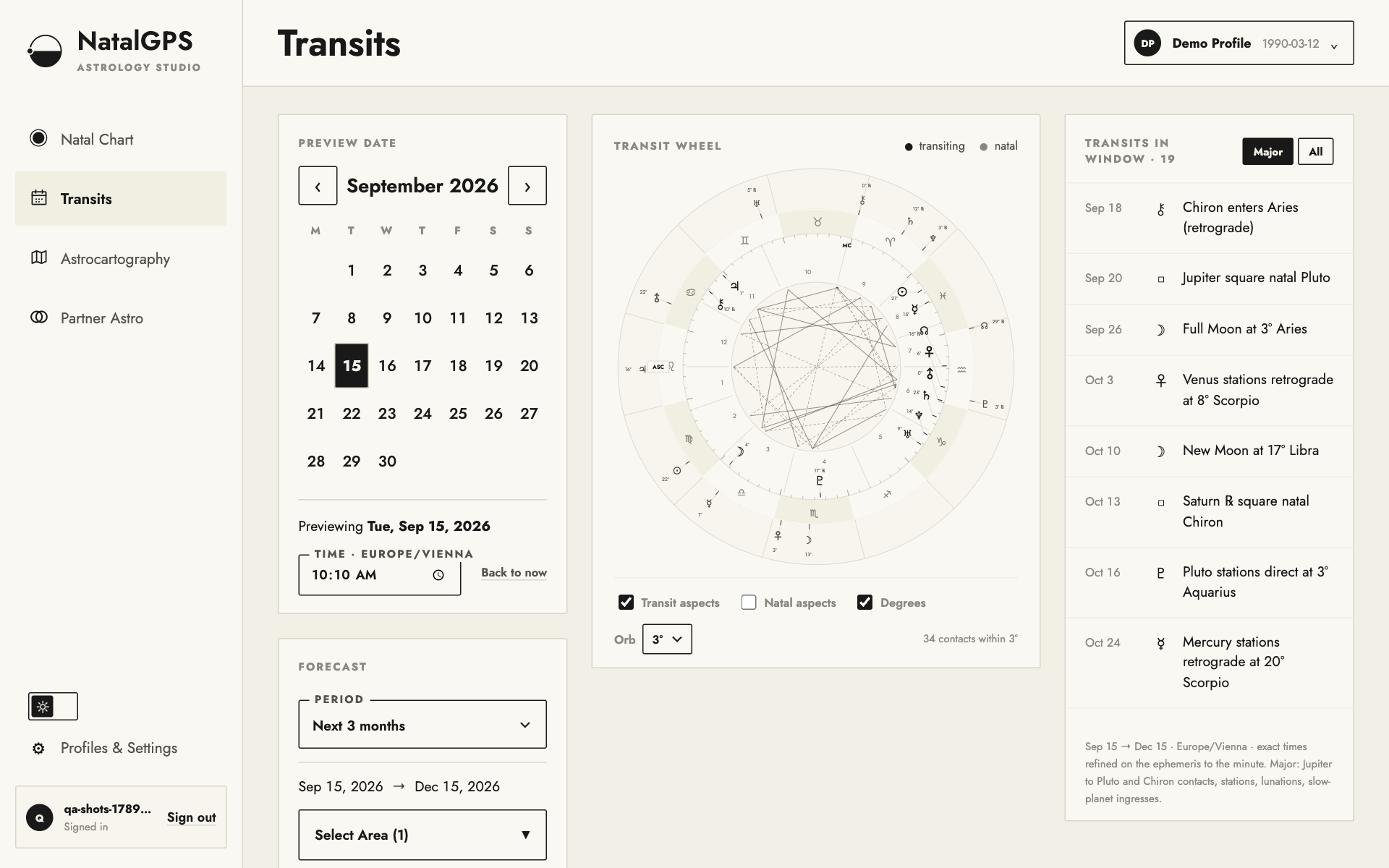
Your natal chart inside, the transiting planets on the outer ring. Pick a day on the month calendar or set the exact time; the wheel redraws at once.
Every contact between a moving planet and your natal planets and angles within your orb, marked applying or separating, with the transiting planet’s natal house.
Exact contacts, sign ingresses, stations and New and Full Moons for the next 3, 6 or 12 months or the whole year, each refined on the ephemeris to the minute.
Choose General, Relationship, Career, Money or Health and receive a written forecast built from those dated transits rather than a generic horoscope.
The wheel opens on the current moment in your birthplace’s time zone. Step through the calendar, or type a time, to preview any day between 1800 and 2399.
The list beside the wheel shows what is exact when, sorted by date. Switch between the major transits and every contact, and widen or narrow the orb.
Choose the period and the life areas you care about. The forecast is written from the exact transit calendar and its key dates.
A transit is a planet in today’s sky forming an aspect to a planet or angle in your birth chart. The slow planets, Jupiter to Pluto, make the transits people remember: a Saturn square that lasts a season, a Pluto conjunction that returns three times across two years as the planet turns retrograde and direct again.
natalGPS samples the sky every day across the chosen window, finds each exact contact and refines it on the ephemeris to the minute. Retrograde loops appear as numbered passes, and every contact carries its window of influence, so you can see when a transit begins, peaks and lets go.
The wheel is a snapshot: the whole sky at one moment against your chart. The calendar is the timeline: what becomes exact on which day. You need both. The snapshot shows the mood of a day; the calendar shows the shape of a season.
By default the list keeps to the major events so it stays readable. Switch to “All” for every contact, including the fast planets.
A few transits arrive for everyone at roughly the same age, and they are the ones people remember. natalGPS lists each of them with its exact dates and, where a planet turns retrograde, every pass.
A transit is strongest at the moment it is exact and felt within an orb of a few degrees on either side. Fast planets pass in a day or two; Saturn takes weeks and Pluto months, and when a slow planet turns retrograde it crosses the same degree three times, so one theme returns across a year or more. natalGPS shows each contact’s window, its applying and separating phase, and every pass, with exact times refined on the ephemeris to the minute in your own time zone.
Look at the next three to twelve months and mark the exact dates of the slow-planet contacts. Read the natal house each one touches, because that is where the theme shows up in daily life. Cross-check with your natal aspects: a transit repeating a natal pattern is louder than a new one. Then choose your timing: launch on the applying side of a Jupiter trine, rest through a Saturn square, sign nothing important in the days around a Mercury station. The written forecast in natalGPS does this reading for the period you choose, by life area.
Transits are the real sky measured against your chart. Secondary progressions move your natal chart symbolically one day per year, and a solar return is the chart of the moment the Sun returns to its natal degree each birthday. Each answers a different question; transits are the most concrete, because their dates are astronomical facts. natalGPS focuses on transits today.
Saturn takes about 29.5 years to circle the zodiac, so it returns to its natal degree around 29 and 58. Open the Transits page, choose the whole year, and look for Saturn conjunct natal Saturn to see your exact dates and passes.
The Transits page opens on today: the bi-wheel shows the current sky around your chart and the list beside it shows every contact within your orb, marked applying or separating.
Yes. Pick any date from 1800 to 2399 on the calendar to see the transit chart for that day, which is useful for checking what the sky was doing at a turning point in your life.
A transit chart places the planets of a chosen moment around your natal chart, so you can see which of your natal planets and angles they are aspecting. natalGPS draws it as a bi-wheel: radix inside, transits outside.
The wheel previews any date from 1800 to 2399. The transit calendar and forecast cover today, the next 3, 6 or 12 months, or the current calendar year.
Contacts from Jupiter, Saturn, Uranus, Neptune, Pluto and Chiron, planetary stations, New and Full Moons and the sign changes of the slow planets. Mercury and Venus appear for conjunctions, oppositions and squares.
Yes. Exact times are converted to the time zone of the birth profile you are viewing, and the wheel’s moment is entered in that zone as well.
No. It describes the themes and timing suggested by the dated transits against your chart, written for reflection. It is not medical, financial or legal advice.