The short answer
Astrology does not name a city for you. What it offers is a lens: for every place on Earth, your birth chart can be recalculated as if you had been born there, and the planets that were angular at your birth trace lines across the map where they would have been rising, setting, overhead or underfoot. Living near a line tends to emphasise that planet in daily life. The rest, the job, the language, the rent, the people you love, still has to be weighed by you.
Used that way, astrocartography is a good tool for a shortlist. It will not settle a decision, but it can make a vague pull into something you can name, compare and test.
How astrology maps a place to your chart
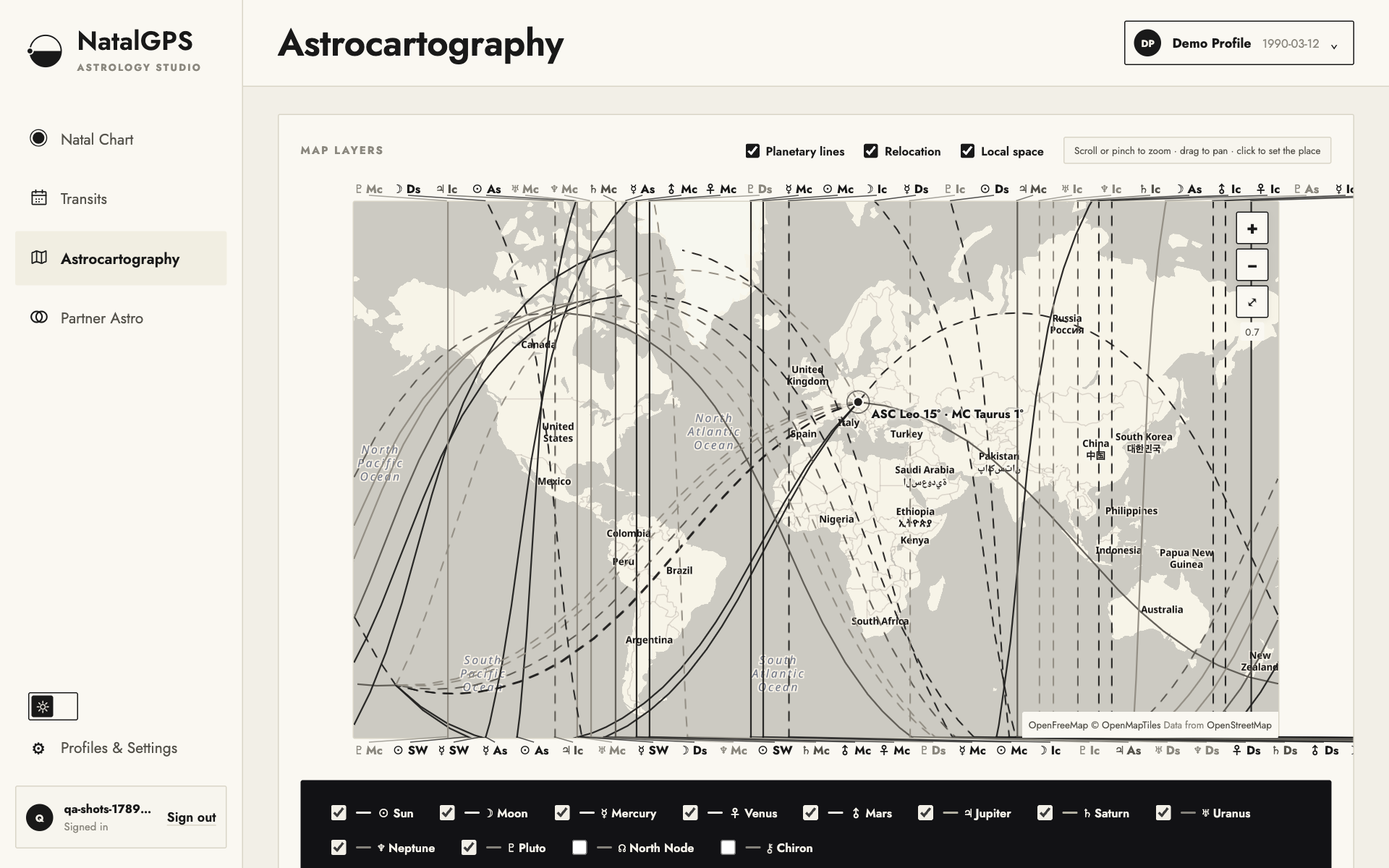
At the instant you were born, each planet was exactly on the horizon or the meridian somewhere on Earth. Draw those places and you get four lines per planet: the Midheaven line where it was culminating, the IC line on the opposite meridian, and the two curves where it was rising and setting. natalGPS draws all four for the Sun, Moon, Mercury to Pluto, the North Node and Chiron, on a detailed world map.
A relocation chart is the second view of the same idea. Keep your birth date and time, change the place, and the Ascendant, Midheaven and houses move while the planets stay where they were. A Venus that sits quietly in your twelfth house at home may land on the seventh-house cusp in Lisbon. The lines and the relocated chart always agree: stand on a line and that planet is on an angle in your relocated chart.
Local space is the third view, and the one people forget. Instead of asking where on Earth a planet was angular, it asks in which compass direction it lay from the place you stand. Some astrologers use it for choosing a direction to move in, or even for arranging a home.
What the main lines tend to mean
Traditional readings run roughly like this. Treat them as starting points, then read the whole relocated chart.
- Sun: visibility, vitality, being seen. Good for careers that need a stage; tiring if you want anonymity.
- Moon: home, belonging, family life, emotional weather. Many people find Moon lines the most livable.
- Mercury: study, writing, trade, conversation. Busy rather than restful.
- Venus: love, friendship, pleasure, and often money made easily. The line most people go looking for.
- Mars: drive and appetite, but also friction and accidents when the rest of the chart is tense.
- Jupiter: growth, opportunity, teachers and luck, along with excess if nothing restrains it.
- Saturn: responsibility, structure, slow-built achievement. Hard at first, solid later. Not a line to avoid on principle.
- Uranus, Neptune, Pluto: change, imagination and transformation respectively, each with a shadow side of instability, fog or intensity.
Midheaven, IC, rising and setting are not the same
The same planet reads differently on each of its four lines. On the Midheaven line it shows in your public role and career. On the IC line it colours home, roots and private life. On the rising line it is in your body and your bearing; on the setting line it arrives through other people, partners and opponents alike. A Venus Descendant line and a Venus Midheaven line are both “Venus lines” and describe quite different years.
A six-step way to use astrocartography for a move
Start with an exact birth time. Four minutes of clock time moves every line by about a degree of longitude, roughly a hundred kilometres at the equator. If your time is from memory rather than a record, treat the whole map as approximate and lean on the slow-moving Midheaven and IC lines, which are the least sensitive.
Open your map and turn on only a few planets at once. Twelve bodies with four lines each is a lot of ink; the picture gets clearer with the Sun, Moon, Venus, Jupiter and Saturn alone.
Make a shortlist of places you could actually move to, then click each one. natalGPS gives you the relocated Ascendant and Midheaven, the planets that change house, the nearest lines and how far away they run.
Compare the relocated charts, not just the lines. A city with no line within five hundred kilometres can still put a planet on an angle in the relocated chart, and that counts.
Check the timing. A move is also a transit event; run the next twelve months of transits for your chart and see what the season is asking before you sign a lease.
Weigh the practical. Astrology can rank three cities you already want to live in; it cannot make a place you dislike into a good idea.
How close to a line is close enough?
Most practitioners read a line as strong within two to three hundred kilometres and fading beyond that, though there is no agreed cutoff. Two things make the question easier in practice. natalGPS lists the nearest lines to any place you click with their distances, so you can see whether a city is on a line or merely near one. And lines that curve near the poles bunch together, so a place at high latitude can sit near several lines at once; read those with care.
Mistakes worth avoiding
Choosing a place for one line and ignoring the rest of the relocated chart. Treating Saturn or Pluto lines as forbidden rather than demanding. Forgetting that a rising-line planet behaves differently from the same planet on the Midheaven. Reading the map with an uncertain birth time as if it were exact. And the most common one: letting the map decide instead of letting it inform.
Where to start in natalGPS
Create your birth chart, open Astrocartography, and click the places on your list. The relocated chart, the local-space directions and the nearest lines update together, and the Transits page tells you what the coming season looks like for the move.