Synastry bi-wheel
Partner A’s chart inside, Partner B’s planets and angles on the outer ring, with the cross-aspects drawn through the centre.
Compare two birth charts for compatibility: one chart laid around the other, every cross-aspect between you, whose planets fall in whose houses, and a written partnership analysis for the topics you choose.
Two saved profiles·Cross-aspects with orb control·Analysis by topic
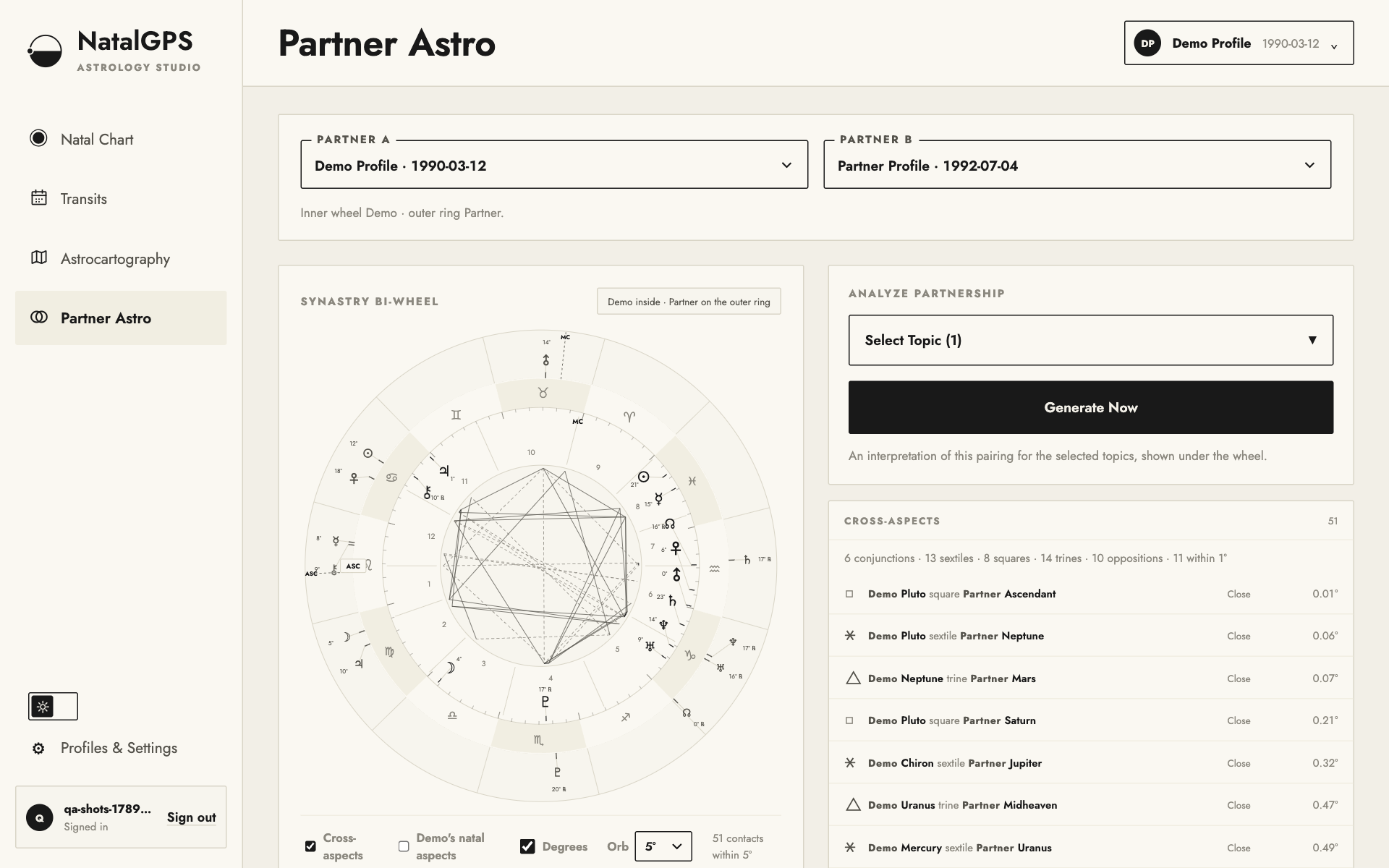
Partner A’s chart inside, Partner B’s planets and angles on the outer ring, with the cross-aspects drawn through the centre.
Conjunctions, sextiles, squares, trines and oppositions between one person’s planets and angles and the other’s, sorted by exactness, with contacts inside 1° flagged.
Where Partner A’s planets fall in Partner B’s houses, and the reverse, so you can see which areas of life each person activates for the other.
A written analysis of the pair for the topics you pick: overall compatibility, communication, emotional bond, romance and attraction, conflict and growth, commitment and longevity.
Each person needs a birth profile: date, time and place. Both stay private to your account.
Pick any two saved profiles. Swap them to read the overlays from the other side, and set the orb you want for the cross-aspects.
The aspect list and overlays update instantly. Choose the topics and the analysis is written from this pair’s actual contacts.
Sun-sign compatibility compares two signs. Synastry compares two whole charts: twelve bodies and four angles each, and every aspect between them. Moon to Moon shows how two people feel at home; Venus and Mars describe attraction; Saturn contacts show where the relationship asks for patience and where it can last.
natalGPS calculates both charts with the same zodiac and house system, so the comparison is consistent, and shows how many contacts fall within one degree, where the strongest themes usually sit.
Start with the closest cross-aspects, then the house overlays: a partner’s Sun in your seventh house or their Moon in your fourth carries meaning that no aspect list shows on its own. Then read the whole against the two natal charts, which natalGPS keeps a click away.
The partnership analysis follows the same order and is written as reflection on the pair, not as a verdict on the relationship.
Cross-aspects describe how two charts touch. natalGPS lists all of them by exactness and flags those within one degree; these are the ones astrologers look at first.
Overlays show which area of your life the other person activates. Their Sun in your seventh house makes them feel like a partner; their Moon in your fourth brings them into your home life; their Venus in your fifth is romance and play; their Saturn in your tenth can be a mentor or a critic; their planets in your eighth or twelfth pull the relationship into deep, private territory. natalGPS shows both directions side by side, because a relationship rarely looks the same from each end.
Synastry compares two complete charts and is the standard tool for compatibility. A composite chart builds a single chart from the midpoints of the two, and a Davison chart casts a chart for the midpoint in time and space; both describe the relationship as a third entity. natalGPS calculates synastry today, with composite and Davison charts planned.
No synastry chart is a verdict. Hard aspects between two charts are where a relationship does its growing, and easy ones are where it rests; a pairing with only trines can be pleasant and dull, one with only squares exhausting. Read the cross-aspects against each natal chart, notice what each person already carries, and let the partnership analysis frame the themes rather than decide for you.
It is accurate about the geometry between two charts. Whether that geometry becomes a good relationship depends on the people. Treat synastry as a map of dynamics, not a score.
They are one contact among dozens. A Sun–Sun square between two charts is real, but a Moon–Venus trine and a Saturn contact to the Ascendant often say far more about how the pair actually works.
natalGPS deliberately shows counts, orbs and overlays rather than a single number. A score hides the texture that makes synastry useful; the partnership analysis describes it instead.
A synastry chart overlays two natal charts to show the aspects between them and where each person’s planets fall in the other’s houses. It is the standard tool for astrological compatibility.
No. A composite chart is a single chart built from the midpoints of two charts. natalGPS calculates synastry, the comparison of two complete charts; composite and Davison charts are planned.
For the house overlays and the angle contacts, yes. Planet-to-planet aspects still work with an approximate time; a chart with an unknown time takes part without houses.
The closest ones, and those involving the Sun, Moon, Venus, Mars, Saturn and the angles. natalGPS sorts the list by exactness and flags every contact within one degree.
Yes. Synastry reads any pair of charts. The analysis topics such as communication, conflict and growth, and commitment apply to every kind of relationship.