Lines for every planet
MC, IC, rising and setting lines for the Sun, Moon, Mercury to Pluto, the North Node and Chiron. Solid lines for MC and rising, dashed for IC and setting, glyphs at the map edge.
Your planetary lines drawn on a detailed world map: where each planet was rising, setting, culminating or anti-culminating at the moment you were born. Zoom in, click a place, and read its relocated chart.
Lines for twelve bodies·Relocation and local space included·Detailed OpenStreetMap base
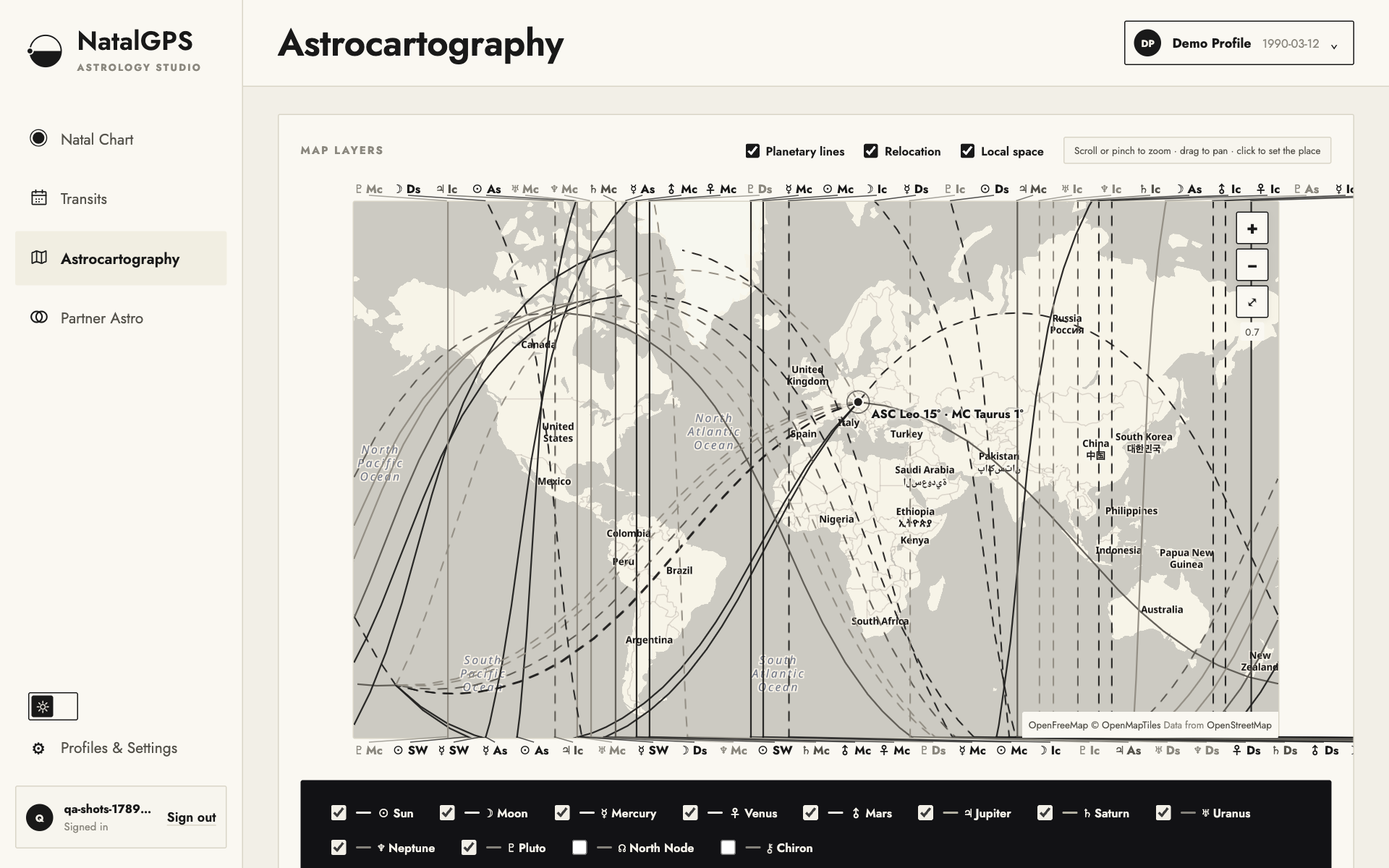
MC, IC, rising and setting lines for the Sun, Moon, Mercury to Pluto, the North Node and Chiron. Solid lines for MC and rising, dashed for IC and setting, glyphs at the map edge.
Click a city and your chart is recalculated for that place: a new Ascendant, Midheaven and houses, with the planets that change house listed beside the wheel.
Compass bearings to each planet from your birthplace or the place you clicked, drawn across the map as great circles and on a compass wheel.
For any spot, the closest planetary lines and how far away they run, so you can weigh a move, a trip or a second home with numbers.
The map uses the same exact birth moment as your natal chart. Nothing to re-enter.
Scroll to zoom, drag to pan, and switch individual planets or whole layers on and off. The glyphs at the edge always tell you which line is which.
Click anywhere to set a place. The relocated angles, the nearest lines and the local-space directions update together.
At the instant of your birth, each planet was culminating somewhere on Earth, anti-culminating on the opposite meridian, rising along one curve and setting along another. Those four lines, drawn for every planet, are your astrocartography map, sometimes called an astro map or relocation map.
natalGPS calculates the lines in mundo from the same Swiss Ephemeris positions as your natal chart and checks them against the relocated house angles, so a line on the map and a relocated chart for a place on that line agree with each other.
People look first for their Sun, Venus and Jupiter lines, and treat Saturn and Pluto lines with more caution. A line’s influence is usually read as strongest within a couple of hundred kilometres and fading beyond that, which is why natalGPS shows the distance to the nearest lines for any place you choose.
Local space astrology asks a different question: not where on Earth a planet was angular, but in which direction it lay from where you stood. natalGPS draws those bearings from your birthplace or from any place you click, on the map and on a compass wheel.
Astrologers read each planet’s lines in the light of that planet’s nature. These are the traditional starting points; the relocated chart tells you how they combine for you.
Each planet has four lines. On the Midheaven (MC) line it was overhead at your birth and colours career, reputation and public role. On the IC line it was underfoot and colours home, roots and private life. On the rising or Ascendant line it was on the eastern horizon and shows in your body, health and bearing. On the setting or Descendant line it was on the western horizon and arrives through partners, clients and the people you meet. A Venus Descendant line and a Venus Midheaven line are both Venus lines and describe different lives.
Astrocartography draws the lines on a world map. Relocation astrology recalculates your whole chart for one place, moving the Ascendant, Midheaven and houses while the planets keep their zodiac positions. Local space asks in which compass direction each planet lay from where you stood. They are three views of one calculation, and natalGPS shows all three at once: click a place and the relocated angles, the nearest lines and the local-space directions update together.
Start from an exact birth time, then shortlist the places you could realistically live or visit and click each one. Compare the relocated charts, not just the lines, and note the distance to the nearest lines, which natalGPS lists for every place. Weigh a demanding line against what you want from that chapter of life: a Saturn line can be exactly right for building a business and wrong for a sabbatical. For travel, lines work in shorter doses; a week on a Venus line is a very different plan from a decade on it.
Venus lines first, especially the Descendant line, then the Moon for closeness and home. Read them together with the relocated seventh house before you book anything.
Sun and Jupiter Midheaven lines for visibility and opportunity, Saturn for slow, solid achievement, Venus for work that pays through relationships and taste.
Yes. Trips are short, so the effect is lighter, but people often choose destinations on Venus, Jupiter or Sun lines for holidays and Saturn or Mercury lines for focused work trips.
Astrocartography maps your birth chart onto the globe: for each planet, the places where it was rising, setting, at the Midheaven or at the IC when you were born. Where you live or travel in relation to those lines is read as emphasising that planet.
Creating the map is free with an account; it is calculated from the same birth profile as your natal chart.
Astrologers commonly read a line as strong within roughly 200 to 300 kilometres and weakening with distance. natalGPS lists the nearest lines and their distances for any place you click, so you can judge for yourself.
Your birth moment recalculated for a different place. The planets keep their zodiac positions, but the Ascendant, Midheaven and houses change, which moves planets into different houses. natalGPS draws it for any place you click on the map.
Yes. The lines depend on the angles, and four minutes of clock time shifts them by about one degree of longitude. If your time is uncertain, treat the map as approximate.