Every placement, to the second
Sun, Moon, Mercury to Pluto, the North Node and Chiron, each with sign, degree, minute and second, retrograde marked, and the house it falls in.
Enter your birth date, time and place and natalGPS draws your natal chart to the minute: planets, houses, angles and aspects, calculated with the Swiss Ephemeris, the same engine professional astrologers rely on.
Swiss Ephemeris precision·Historical time zones·Six house systems
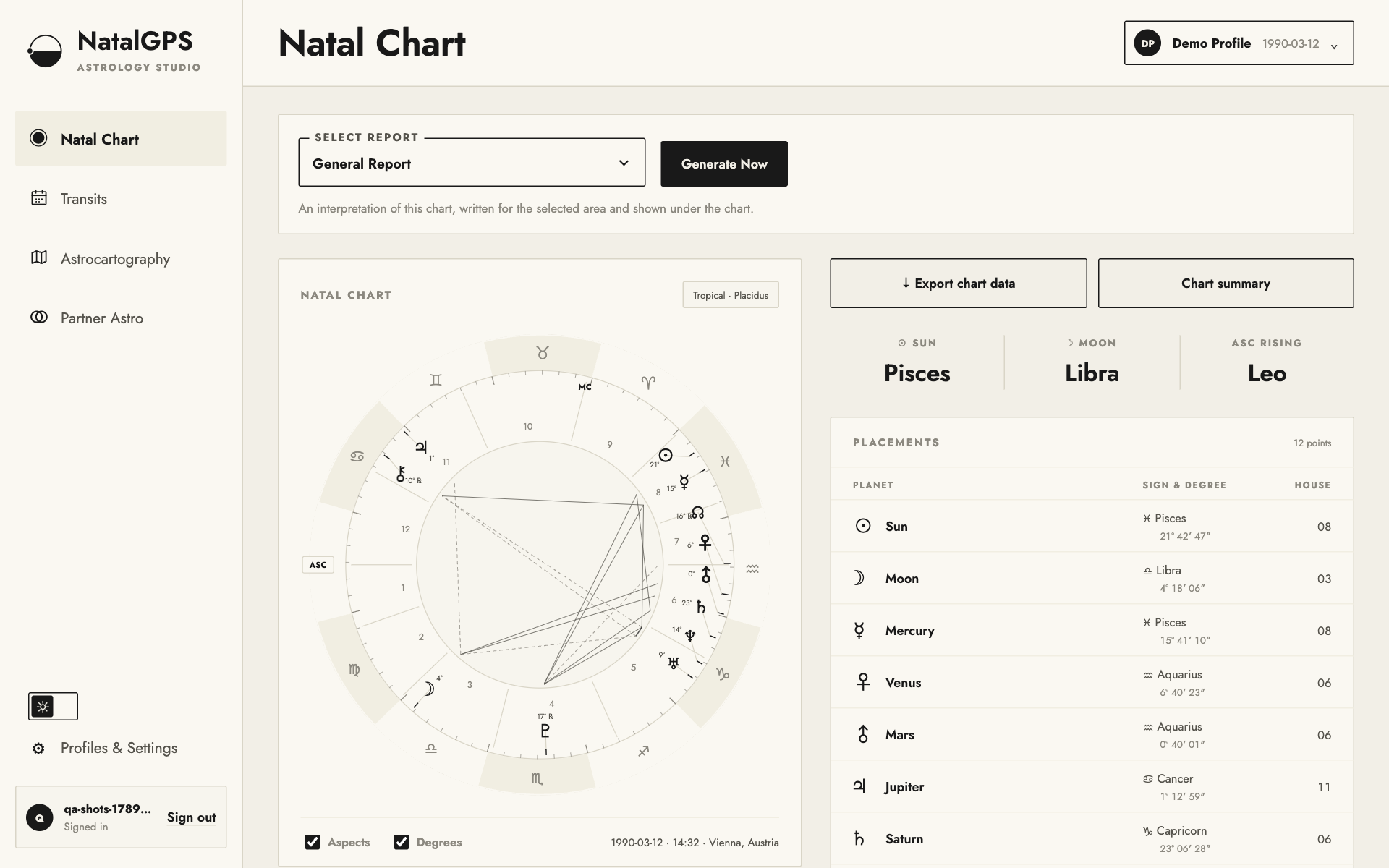
Sun, Moon, Mercury to Pluto, the North Node and Chiron, each with sign, degree, minute and second, retrograde marked, and the house it falls in.
Placidus, Whole Sign, Equal, Koch, Regiomontanus or Campanus houses, with the Ascendant, Midheaven, Descendant and IC marked on the wheel.
Conjunctions, sextiles, squares, trines and oppositions, shown as applying or separating, within an orb you set between 1° and 12°.
Switch zodiacs in one click. Sidereal charts use the Lahiri or Fagan–Bradley ayanamsa; the wheel and the tables recalculate together.
Date, time and birthplace. Search any city in the world; the coordinates and the historical time zone fill in for you.
Your chart appears with the placement table, the aspect list and the house cusps beside it. Toggle aspects and degrees or change the house system and everything recalculates.
Choose General, Relationship, Career, Money or Health and receive a written report grounded in your actual placements, not your Sun sign.
A birth chart, also called a natal chart, is a map of the sky at the moment and place you were born: where each planet stood along the zodiac, which sign was rising on the eastern horizon, and how the sky divided into twelve houses from that spot on Earth.
natalGPS converts your local birth time to universal time with the historical rules for your birthplace, including daylight saving as it was in that year, then asks the Swiss Ephemeris for the apparent geocentric position of every body. The Ascendant, Midheaven and house cusps follow from the exact time and coordinates, which is why the time matters so much: the Ascendant moves about one degree every four minutes.
If your birth time is unknown, choose that option and the calculator uses noon at your birthplace and leaves houses and angles out rather than guessing them.
The names differ, the calculation does not. Whatever you call it, the chart holds the same ten planets, the nodes, Chiron, twelve houses and the aspects between them. natalGPS shows all of it in one view and keeps the chart in your account as a profile, so you can return to it, compare it with a partner’s, run transits against it or map it across the world.
Written reports turn the geometry into language. Each report is generated from your own placements, houses and aspects and is framed as reflection rather than prediction.
A natal chart has four layers, and reading it means holding them together. Planets are the what: the Sun is your identity, the Moon your needs, Mercury your mind, Venus your affections, Mars your drive, and so on out to Pluto. Signs are the how: the style each planet works in. Houses are the where: the area of life in which it plays out. Aspects are the relationships between planets, the angles that make two of them cooperate, argue or reinforce each other.
natalGPS draws all four layers on one wheel and lists them in the placement and aspect tables beside it, so a beginner can start with the big three and a practitioner can go straight to the tight squares.
Start with the big three: the Sun sign for identity, the Moon sign for emotional life, the rising sign for how you meet the world. Then find the chart ruler, the planet that rules your rising sign, and see where it sits. Next read the planets house by house, because a Venus in the tenth house lives a different life from a Venus in the fourth. Then look at the tightest aspects, the ones within a degree or two, which describe your recurring themes. Finally step back and look at the pattern: clusters of planets, empty halves, the balance of elements. natalGPS shows the orb of every aspect so the tight ones are easy to find.
House systems divide the sky above your birthplace into twelve parts, and they disagree about how. Placidus, the most common in Western astrology, divides the time a point takes to rise and culminate. Whole Sign gives each sign one house, starting with the rising sign. Equal cuts twelve 30° houses from the Ascendant. Koch, Regiomontanus and Campanus are further quadrant systems with their own geometry. Planets near a house cusp can change house between systems, which is why natalGPS lets you switch systems in one click and recalculates the wheel and the tables together. At far northern or southern latitudes the time-based systems break down, and natalGPS tells you to use Whole Sign or Equal.
The tropical zodiac, used by most Western astrologers, starts Aries at the spring equinox. The sidereal zodiac, used in Vedic and some Western traditions, anchors the signs to the stars; the two have drifted about 24° apart, so a tropical Aries Sun is often a sidereal Pisces Sun. natalGPS calculates both, with the Lahiri or Fagan–Bradley ayanamsa for sidereal charts, from the same birth data.
A newspaper horoscope uses one fact about you, the Sun sign, and writes for a twelfth of humanity. A birth chart uses the whole sky at your exact minute and place, which is why two people with the same Sun sign can have almost nothing else in common. Free birth chart calculators exist in many places; what sets natalGPS apart is that the same chart then feeds transits, astrocartography and synastry, and that every number can be checked against the ephemeris.
Nothing: they are two names for the same calculation, the sky at your birth seen from your birthplace. “Astrology chart” and “zodiac chart” usually mean the same thing too.
The Ascendant is the sign rising on the eastern horizon at your birth. It describes your bearing, first impressions and the body, and it sets the houses, which is why it needs an exact time.
Check your birth certificate or hospital record; in many countries the long-form certificate carries the time. Family memory is a last resort. If you only know the hour roughly, enter it and treat houses as approximate; if not at all, choose “Unknown”.
Calculating your natal chart is free with an account. The pricing page lists what each plan includes beyond the chart itself, such as the written reports.
Choose “Unknown” for the time. natalGPS calculates the planets for noon at your birthplace and omits houses and angles instead of inventing them. The Moon can move up to about 14° in a day, so its sign may still be uncertain.
Placidus is the default and the most common in Western astrology; Whole Sign is a close second. At very high latitudes Placidus cannot be calculated, and natalGPS tells you to switch to Whole Sign or Equal.
Planetary positions come from the Swiss Ephemeris, which is accurate to fractions of an arc second. Time conversion uses the IANA time-zone database with its historical rules; charts before 1970 carry a reminder to verify the offset in old records.
Yes. Every chart is saved as a birth profile in your account. Switch between them from the selector at the top right, edit any of them, and use two of them together in Partner Astro.